Meta Title: Custom Soft PTFE Gasket Wholesale: Sizing, MOQ & Lead Time
Meta Description: Source wholesale custom soft PTFE gaskets with tight tolerances, food-grade resin, a -200°C to 260°C range, low MOQ and fast lead time from an OEM factory.
Picture this: a batch of 5,000 soft PTFE gaskets lands at your plant, and 18% of them weep at 0.8 MPa on the very first pressure test. Your line is down, your flange faces are corroding, and the supplier—brands A, B and C among them—is quoting a six-week replacement. For procurement managers, gasket failure is rarely a materials problem; it is a sourcing problem. Buyers searching for wholesale and custom soft PTFE gaskets need a specification, a supplier shortlist and a QA plan—not another catalog. This guide covers what to specify, how to compare factories, and where the hidden costs live.
What Is a Soft PTFE Gasket, and Why Buyers Specify It
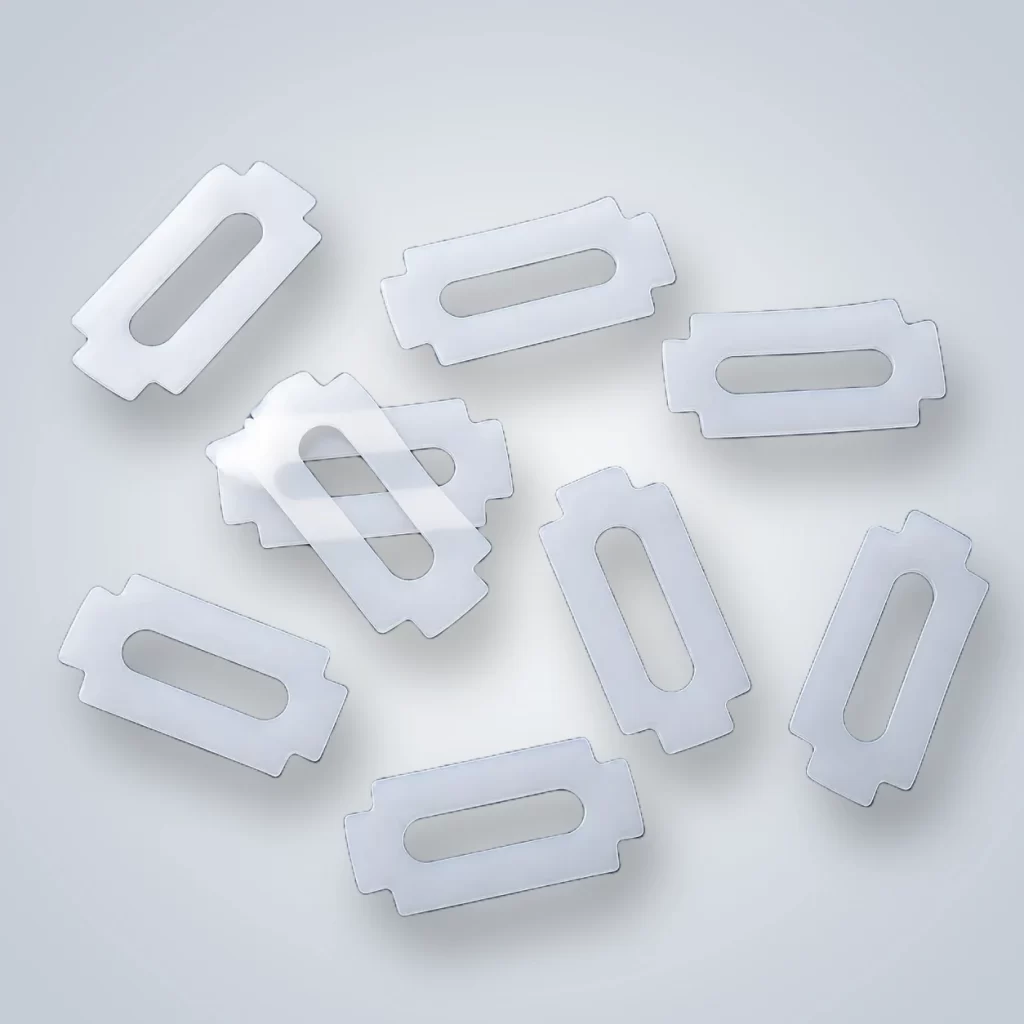
A soft PTFE gasket is a conformable, highly compressible seal cut or molded from polytetrafluoroethylene rather than a rigid, heavily filled engineering plastic. Because virgin PTFE has a Shore D hardness of roughly 50, it deforms easily under low bolt load and flows into the microscopic valleys of flange faces, glass-lined equipment and pipe surfaces that harder materials cannot wet out—see Hennig Gasket’s PTFE reference for the hardness and food-contact rationale. That conformability is the whole selling point: it seals damaged, uneven or low-torque flanges where rubber and compressed-fiber gaskets fail.
Core Properties That Should Drive Your Specification
Before you ask factories for a quote, lock down four properties. First, the temperature window: PTFE retains useful properties from about -200°C up to a continuous 260°C, with a crystalline melting point near 327°C, according to the Teflon™ PTFE product selection guide. Second, near-universal chemical inertness, which is why it dominates pharma, semiconductor and corrosive-fluid lines. Third, creep—the classic PTFE weakness. Ordinary virgin PTFE cold-flows under sustained load; expanded PTFE (ePTFE) is fibrillated specifically to resist that, as demonstrated in GORE Universal Pipe Gasket data. Fourth, fillers. Glass, carbon and graphite raise creep and wear resistance but make the seal stiffer—the trade-offs are explained in RAM Gaskets’ PTFE material guide. If you are choosing between resin grades, read our comparison of virgin vs filled PTFE before you commit.
Wholesale vs. Custom: Which Route Fits Your Bill of Materials?
Wholesale buying suits standard ASME/DIN flange sizes, stocking programs and high-volume repeat orders: you pull from tooling that already exists, pay a lower unit price and accept longer MOQs. Custom buying is for non-standard IDs/ODs, unusual thicknesses, special cross-sections or marked parts. Many buyers blend both—stock wholesale for spares, custom for the problem flanges. You can review our range of wholesale custom soft PTFE gaskets and compare them against a standard virgin PTFE gasket to see the conformability difference side by side.
How to Specify a Custom Soft PTFE Gasket
Send the factory inner diameter, outer diameter, thickness, tolerance (typically ±0.05–0.10 mm on machined parts), the flange surface finish, the media, pressure and temperature. Multi-directional ePTFE sheet such as the KLINGER® soft-chem data sheet (1.5–3.0 mm, rated to 260°C) is a proven baseline for soft, conformable service. For damaged or delicate flanges, favor ePTFE; for high-pressure service, favor filled grades—the decision tree is laid out in Dobson Gaskets’ technical guide. And if your operating envelope pushes past 260°C, evaluate other high-temperature plastics rather than over-specifying PTFE.
MOQ, Lead Time and Quality Certifications
A professional OEM should offer low trial MOQs (often 50–200 pieces for custom tooling), lead times of 7–15 days for die-cut parts and 15–25 days for CNC-machined prototypes, plus material certificates. Ask for FDA 21 CFR 177.1550 compliance for food/pharma contact, RoHS and REACH declarations, and a batch test report covering thickness, density and Shore hardness. Brands A, B and C all quote similar specs on paper; the differentiator is whether the factory ships first-article samples before mass production.
Beyond the Assembly Line: A Sourcing Note for Marketing Teams
One pattern we see repeatedly: the same procurement managers who qualify our seals also run branded-merchandise budgets. At industry trade shows, engineering firms bundle their custom seal orders with wholesale custom plush toys—branded mascots handed to visitors as lead magnets. The sourcing logic is identical: low MOQ, custom shapes and colors, consistent quality and a reliable lead time. If your team is already negotiating a factory for soft PTFE gaskets, it is worth asking whether they can coordinate promotional giveaways in the same shipment, simplifying logistics for your next exhibition.
Frequently Asked Questions
What is the minimum order quantity (MOQ) for custom soft PTFE gaskets?
Most OEM factories accept trial orders of 50–200 pieces for custom die-cut or machined gaskets, with unit prices dropping sharply at 1,000+ pieces. Standard wholesale sizes are often available from stock with no MOQ.
What temperature range can soft PTFE gaskets handle?
Soft PTFE gaskets typically perform from -200°C to +260°C continuous service, with a melting point near 327°C. They are suitable for cryogenic lines and steam/SIP environments within that window.
Can you produce non-standard sizes and thicknesses?
Yes. Custom IDs, ODs, thicknesses from 0.5 mm upward, and special cross-sections are produced by die-cutting or CNC machining to your drawing, with tolerances around ±0.05–0.10 mm.
What is the typical lead time for a wholesale order?
Stock wholesale parts ship within 3–7 days. Custom orders usually take 7–15 days for die-cut gaskets and 15–25 days for machined prototypes, depending on complexity and quantity.
Are soft PTFE gaskets food-grade and certified?
Virgin and ePTFE grades can be supplied with FDA 21 CFR 177.1550, RoHS and REACH declarations, making them suitable for food, beverage, pharmaceutical and semiconductor contact applications.
How does soft PTFE compare to filled PTFE for sealing?
Soft/virgin PTFE conforms best on damaged or low-bolt-load flanges but creeps more under pressure. Filled PTFE (glass, carbon, graphite) resists cold flow and handles higher pressure but is stiffer and less conformable.
Do you offer samples before bulk production?
Reputable suppliers ship first-article samples for dimensional and pressure validation before mass production, reducing the risk of the 18%-defect scenario that opens this guide.
Disclaimer
This article is provided for general informational purposes only and reflects typical industry ranges as of the publication date. It does not constitute engineering, legal or procurement advice. Actual performance depends on flange condition, media, pressure, temperature and installation practice; always verify specifications with qualified engineers and your chosen supplier. Competitor references (brands A, B and C) are anonymized for comparison. Consult the original manufacturer technical documents cited above for authoritative material data.