Meta Title: Custom PTFE Magnetic Stir Bars: Lab
Meta Description: カスタムPTFEマグネティックスターバー:八角形、卵形、円筒形、ピボットリング、アルニココア、FDA/USPクラスVI、HF耐性、OEM最小注文数量(MOQ)、カラーコーディング。.
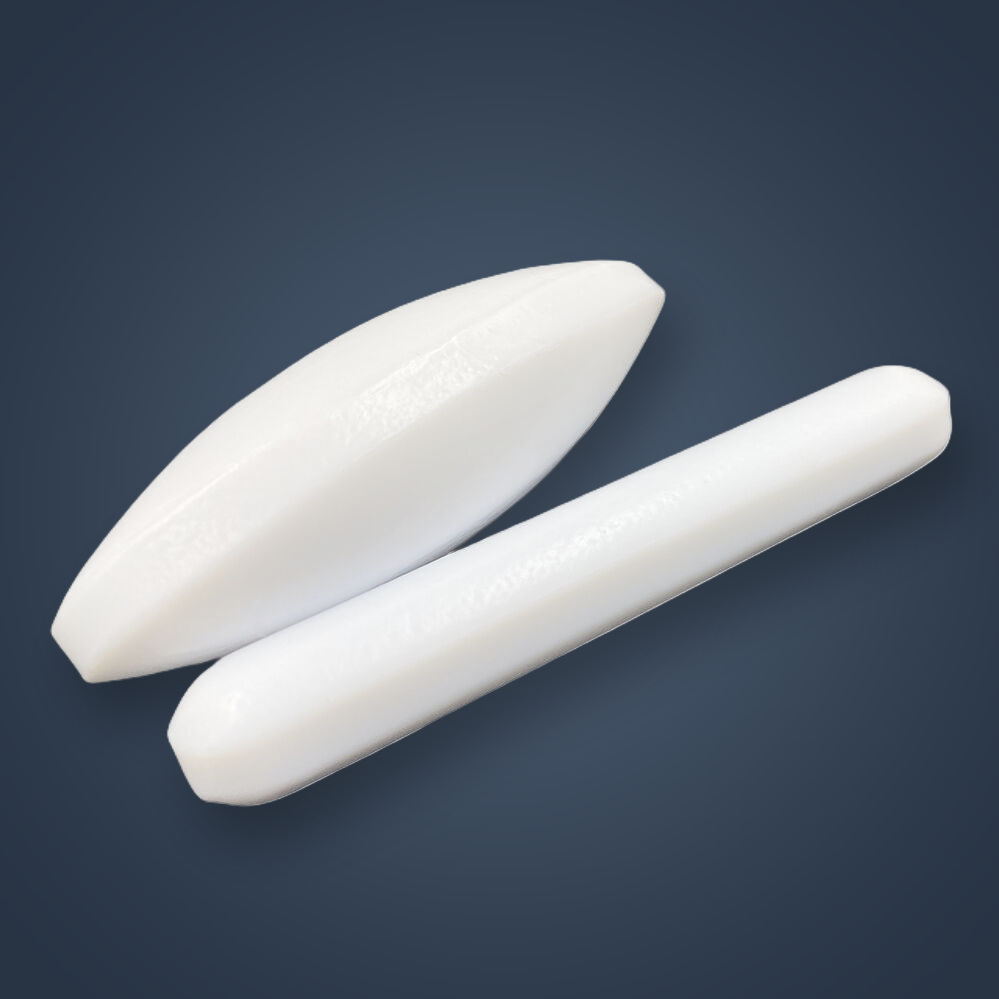
That little white capsule spinning in your flask? It contains more precise magnetic alignment and coating engineering than the transmission of the car you drove to work today—and it costs $1.80. A PTFE magnetic stir bar is a sealed Alnico magnet injection-molded inside a seamless virgin-PTFE shell, balanced to spin at 1,500 rpm without wobble, hermetically impervious to HF, aqua regia and boiling solvent. Yet buyers still treat it as a consumable and reorder whatever brand A, B or C has on the shelf. The difference between a bar that stays centered for three years and one that flips and bounces on day six is the magnet grade, the shell weld, and the shape matched to the vessel. Here is how to specify the right one.
Why PTFE Is the Only Real Choice
A stir bar’s shell must be inert, non-contaminating, smooth and thin. Virgin PTFE is the default because it is chemically universal (pH 0–14, HF, halogens, organics), cryogenic to +260 °C, FDA-grade and USP Class VI compatible, and low-friction enough to spin for months without wearing the flask bottom. Glass-coated bars chip, polyethylene swells in solvent, and bare magnets corrode in days. The industry-standard encapsulation is Alnico magnet inside a continuous PTFE jacket, as catalogued by the SP Bel-Art Spinbox assortment range, which explicitly specifies FDA-grade, USP Class VI PTFE over Alnico cores.
Shape Is Not Cosmetic: Match the Bar to the Vessel
The geometry decides whether you get a vortex or a mess. Cylindrical bars are the general-purpose baseline. Octagon bars with an integral pivot ring are the most common: the interrupted face adds turbulence and the pivot ring keeps the bar off the glass, per the Spinbar shapes and performance guide. Egg-shaped (elliptical) bars are contoured to sit flat in round-bottom flasks, as the elliptical Spinbar spec describes. Polygon bars without a pivot ring hug the vessel bottom to scrape settled solids. Micro “flea” bars fit 1.5 mL vials. The full shape-and-material range stocked by lab distributors such as Cole-Parmer stir bars and the companion UK catalog is a useful benchmark for what OEMs expect.
Specifying a Custom PTFE Stir Bar
Send the drawing with bar length, diameter, shape (cylindrical / octagon / egg / pivot-ring / with-handle), and required magnet grade (standard Alnico for most duty; rare-earth for viscous or deep vessels). Critical details: seamless PTFE shell with no exposed weld, balanced center of gravity, and virgin unfilled PTFE for pharma or ultra-trace work. Pair the stir bar with matched labware—PTFE jars for digestion and storage, PTFE plates for hotplate and stirrer-surface liners, PTFE bushings for stand and clamp bosses, and PTFE spacers for stacking and alignment. Sourcing the stir bar and the surrounding PTFE labware from one factory keeps the leachables profile consistent across the whole sample path.
Applications: Pharma, ICP-MS, Electrochemistry and Synthesis
Four labs drive custom stir-bar volume. Pharma and GMP synthesis needs USP Class VI, lot-traced, color-coded bars. ICP-MS and trace-metal digestion needs virgin PTFE with zero glass and zero metal filler. Electrochemistry and battery-cell research needs bars that won’t shed ions into electrolyte. Scale-up and pilot plants need oversized, rare-earth-core bars up to 150 mm for 20 L reactors. The octagon pivot-ring design, shown in the octagon Spinbar product spec, is the default workhorse across all four because its interrupted face generates more turbulence than a smooth cylinder at the same rpm.
Quality Checks Before You Accept the Lot
Ask for a mill certificate naming virgin PTFE grade, an extractables/leachables report, and a spin-balance check (run every sample bar on a test stirrer at 1,000 rpm for 30 seconds; no wobble, no flip, no audible chatter). Confirm the shell is seamless and that the color-coding (if requested) is pigmented in the PTFE, not surface-printed, so it cannot wear off into the sample. Brands A, B and C all sell “PTFE stir bars”; the one that hands over the lot trace and the balance report is the one worth reordering.
よくある質問
PTFE製スターバーは、どのような形状のものを選べばよいでしょうか?
汎用平底フラスコ用の円筒形;最適な乱流とガラスへの摩耗を最小限に抑えるためのピボットリング付き八角形;丸底フラスコ用の卵形;沈殿した固形物を掻き出すためのピボットリングなしの多角形;バイアル用のマイクロフリーバー。.
私のフラスコにはどのサイズのスターバーが合うでしょうか?
Rule of thumb: bar length about one-third to one-half the vessel diameter. A 25 mm bar for a 100 mL flask, a 50 mm bar for a 500 mL flask, and up to 80–120 mm rare-earth-core bars for pilot reactors.
PTFE製スターバーは、HFおよびICP-MSの作業において安全ですか?
はい。バージンPTFEはHFおよび事実上すべての酸に対して不活性です。微量金属分析やICP-MS用途には、充填剤を含まないバージンPTFE(ガラスや青銅の充填剤を含まないもの)をお選びください。.
What temperature can PTFE stir bars handle?
The PTFE shell serves from about -200 °C to +260 °C; the encapsulated Alnico magnet loses strength above its Curie point, so most bars are rated for continuous bath use up to about 120–150 °C.
Can you supply colored, labeled or logo-branded stir bars?
Yes. We pigment virgin PTFE for blue, red, yellow, green or amber color-coding, and can laser-mark lot codes for GMP and traceability workflows.
What is the MOQ and lead time?
Trial orders start at roughly 100–500 bars; custom-shaped PTFE stir bars ship in 10–20 days, with first-article balance and leachables reports approved before production.
免責事項
This article is provided for general informational purposes only and reflects typical industry ranges as of the publication date. It is not engineering, safety, clinical or regulatory advice. Stir bars for pressure-boundary, hazardous, medical, food or regulated service must be validated by the user against the actual chemistry, temperature, vessel and speed. Always follow the magnetic-stirrer manufacturer’s guidance on bar size and speed. Competitor references (brands A, B and C) are anonymized for comparison. Consult the cited labware manufacturers for authoritative product specifications.