Meta Title: Custom PTFE Stopper: Threaded, Tapered & Molded Guide
Meta Description: Source custom PTFE stoppers and threaded PTFE plugs: tapered, threaded or molded to drawing, FDA virgin resin, -200 to 260C, low MOQ and fast lead time.
Why are nearly 70% of OEM buyers still sealing aggressive chemical vessels with off-the-shelf rubber or cork stoppers when the global PTFE machining market keeps climbing at a high single-digit annual rate, driven precisely by the corrosion and contamination failures those legacy plugs cause? The numbers are clear: PTFE resists hydrofluoric acid, organic solvents and repeated autoclaving that degrades elastomers within months, yet most buyers default to catalog stoppers because custom parts look slow and expensive. In practice, a custom PTFE stopper or PTFE plug manufacturer can deliver a drawn, threaded or tapered part in days at pennies over the catalog price. This guide walks through geometries, tolerances, certifications and sourcing for custom PTFE stoppers.
What Is a PTFE Stopper, and When Do You Specify One?
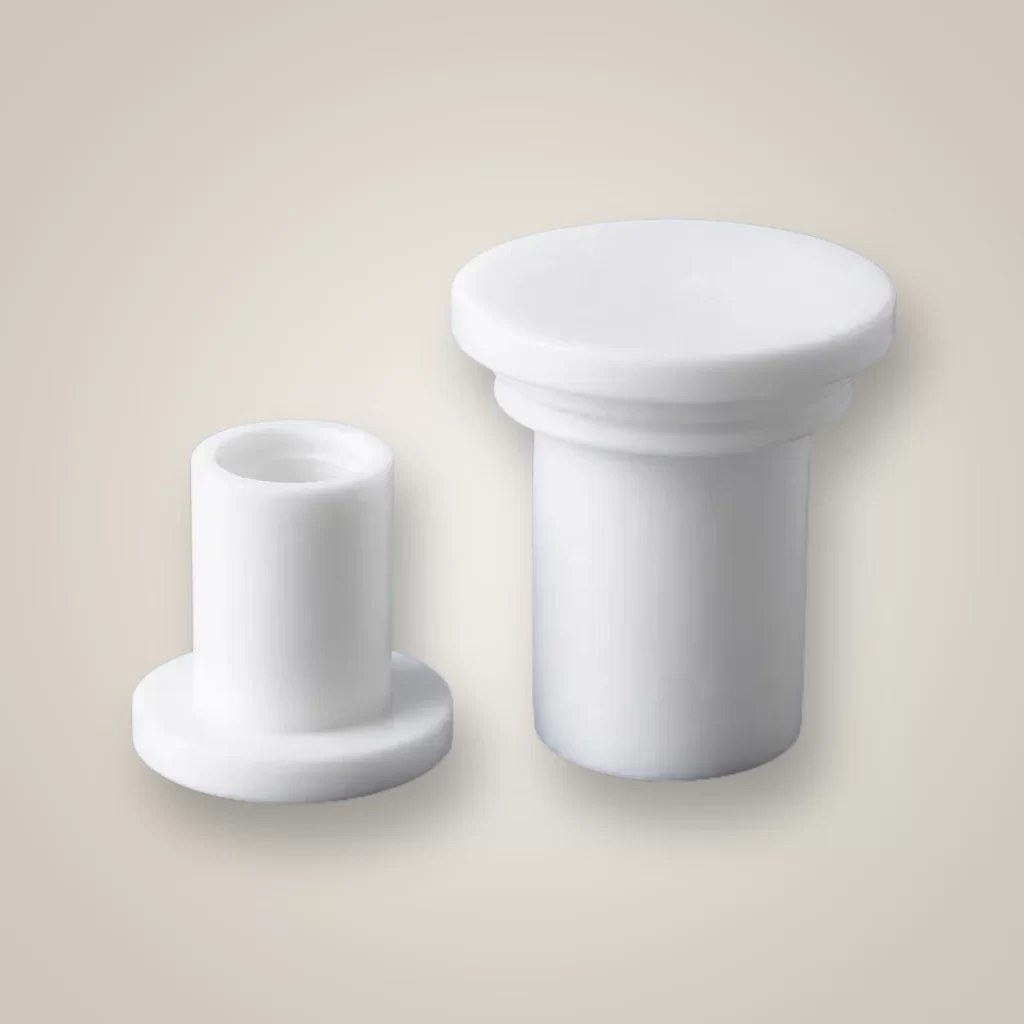
A PTFE stopper is a precision plug—tapered, flanged, threaded or molded—used to seal a bore, vessel neck, port or test opening where chemical inertness, cleanliness and temperature stability matter. Unlike rubber, PTFE does not swell in solvents, does not leach plasticizers, and survives cryogenic to 260 °C service. That makes it the default choice for laboratory glassware, chemical-drum bungs, instrumentation ports, HPLC and semiconductor handling, where a contaminated or swollen plug ruins the batch. Brands A, B and C all list generic “Teflon plugs,” but the performance gap appears the moment your bore geometry, thread pitch or sterilization cycle falls outside the catalog.
Threaded, Tapered and Molded: Pick the Right Geometry
Tapered (conical) stoppers seal by radial compression into a matched bore—ideal for glass necks and one-hand operation. Threaded PTFE plugs give positive, repeatable torque for pressurized or vibration-prone ports. Molded custom PTFE stoppers add flanges, ribs, grab handles or undercuts that machining cannot cost-effectively produce. Custom T-shaped sealing hole stoppers in PTFE are a proven waterproof/dustproof, chemically inert option for industrial and lab fasteners, as the Kintek PTFE screw-plug reference details. Virgin PTFE stoppers hold up across -200 °C to +260 °C against acids, bases and organic compounds, per the Custom PTFE Stopper spec sheet.
Material Properties: Chemical, Thermal and Regulatory
Virgin PTFE is FDA-listed under 21 CFR 177.1550 for repeated food contact, and a reputable supplier will issue a Certificate of Conformance that actually cites that code rather than a vague “food-grade” claim—see the Ready Plastics PTFE FAQ. Its regulatory advantage is structural: virgin PTFE inherently meets low extractives limits (around 3.1 mg/dm² total and 0.46 mg/dm² fluoride) and is accepted under 3A sanitary and USDA guidance, as explained in Artesian Systems’ PTFE-versus-elastomer comparison. For pharma and food lines, that means no flavor pick-up, no discoloration and no elastomer fragments in the vessel.
Machinability: Soft Material Needs Smart Design
PTFE machines easily but springs back, creeps and expands thermally, so holding tight sealing diameters demands a specific process: rough machine oversize, stabilize/anneal, then finish the sealing bore. As Xometry’s PTFE machining guide notes, the material’s low strength and softness make precision harder than with rigid engineering plastics, and CNCMF’s PTFE material manual recommends light clamping, air cooling and measuring only after thermal stabilization. Specify the sealing diameter (the bore that mates your vessel) as the controlled dimension, leave generous radii, and call out annealing—this is what separates a sealing stopper from one that leaks on the first autoclave cycle.
Wholesale vs. Custom: MOQ, Lead Time and Pairing Parts
Three drawing choices save a sample round: call out only the sealing bore as a held dimension (not the whole outside profile), request annealed virgin resin for sterilization-heavy parts, and add a light lead-in chamfer so the plug self-aligns on insertion. Glass- or carbon-filled PTFE is available where lower creep matters more than absolute chemical universality, but virgin remains the safe default for HF and food contact.
Stock tapered bungs suit standard lab glassware, but once your neck ID, thread or flange is non-standard, custom wins on fitment and rejection rate. Expect trial MOQs from 50–200 pieces, 7–15 day die-cut/CNC lead times and first-article samples with a dimension report. Stoppers rarely work alone: they seal PTFE vials and PTFE reaction vessels, complement PTFE magnetic stir bars inside the flask, and thread into ports you wrap with PTFE thread seal tape for a zero-leak joint. Sourcing the whole sealing set from one factory removes fit-up surprises between suppliers.
Frequently Asked Questions
What is the difference between a tapered and a threaded PTFE stopper?
Tapered stoppers seal by radial compression into a matched bore and suit glass necks and quick removal; threaded PTFE plugs give positive, repeatable torque for pressurized, hot or vibration-prone ports.
Can you produce custom molded PTFE stoppers with flanges or handles?
Yes. We machine custom IDs, OD, tapers and thread pitches to drawing, and can produce molded flanges, grab ribs, undercuts and logo marks for high-volume applications.
What temperature and chemicals do PTFE stoppers withstand?
Virgin PTFE stoppers run from about -200 °C to +260 °C continuous and resist virtually all acids, bases, solvents and organics, including HF and HNO₃, except molten alkali metals and elemental fluorine.
Are PTFE stoppers food-grade and FDA-compliant?
Virgin grades can be supplied with 21 CFR 177.1550 documentation, low extractives and 3A/USDA-compatible certificates, making them suitable for food, beverage, pharmaceutical and laboratory contact.
What is the MOQ and lead time for custom PTFE stoppers?
Trial custom orders typically start at 50–200 pieces, with lead times of 7–15 days for machined parts; stock tapered bungs ship from inventory with little or no MOQ.
Which industries rely on custom PTFE stoppers most?
Laboratory and analytical instruments, pharmaceutical and chemical processing, semiconductor handling, food and beverage filling, and instrumentation/port sealing are the heaviest users.
Disclaimer
This article is provided for general informational purposes only and reflects typical industry ranges as of the publication date. It is not engineering, legal or procurement advice. Actual sealing performance depends on bore geometry, mating material, media, pressure, temperature and sterilization regime; always validate parts with qualified engineers and your supplier. Competitor references (brands A, B and C) are anonymized for comparison. Consult the cited manufacturer and regulatory documents for authoritative material and compliance data.