Meta Title: Custom Small PTFE Washers: Sizing, Tolerance & MOQ
Meta Description: จัดหาแหวนรอง PTFE ขนาดเล็กตามสั่ง ด้วยความคลาดเคลื่อนที่แม่นยำ +/-0.05 มม. ขนาดเส้นผ่านศูนย์กลางภายใน/ภายนอกและความหนาตามแบบวาด ผลิตจากเรซินระดับอาหาร ปริมาณสั่งขั้นต่ำต่ำ และระยะเวลาการผลิตที่รวดเร็ว.
A European medical-device assembler was scrapping roughly 12,000 units a year. The root cause was not a pump, a sensor or a valve—it was a 6 mm ID PTFE washer that swelled 0.15 mm after autoclaving and bound the plunger in a reusable insulin injector. Their buyer switched suppliers—brands A, B and C had all quoted the same “standard” part—until we machined the washers from annealed, virgin PTFE to a held +/-0.05 mm tolerance. The scrap rate fell to under 0.3%. This is the quiet economics of small PTFE washers: the part costs pennies, but the spec you neglect decides whether your whole assembly ships. Below is the sourcing playbook for custom small PTFE washers and small PTFE washer wholesale.
What Are Small PTFE Washers, and Where Do They Shine?
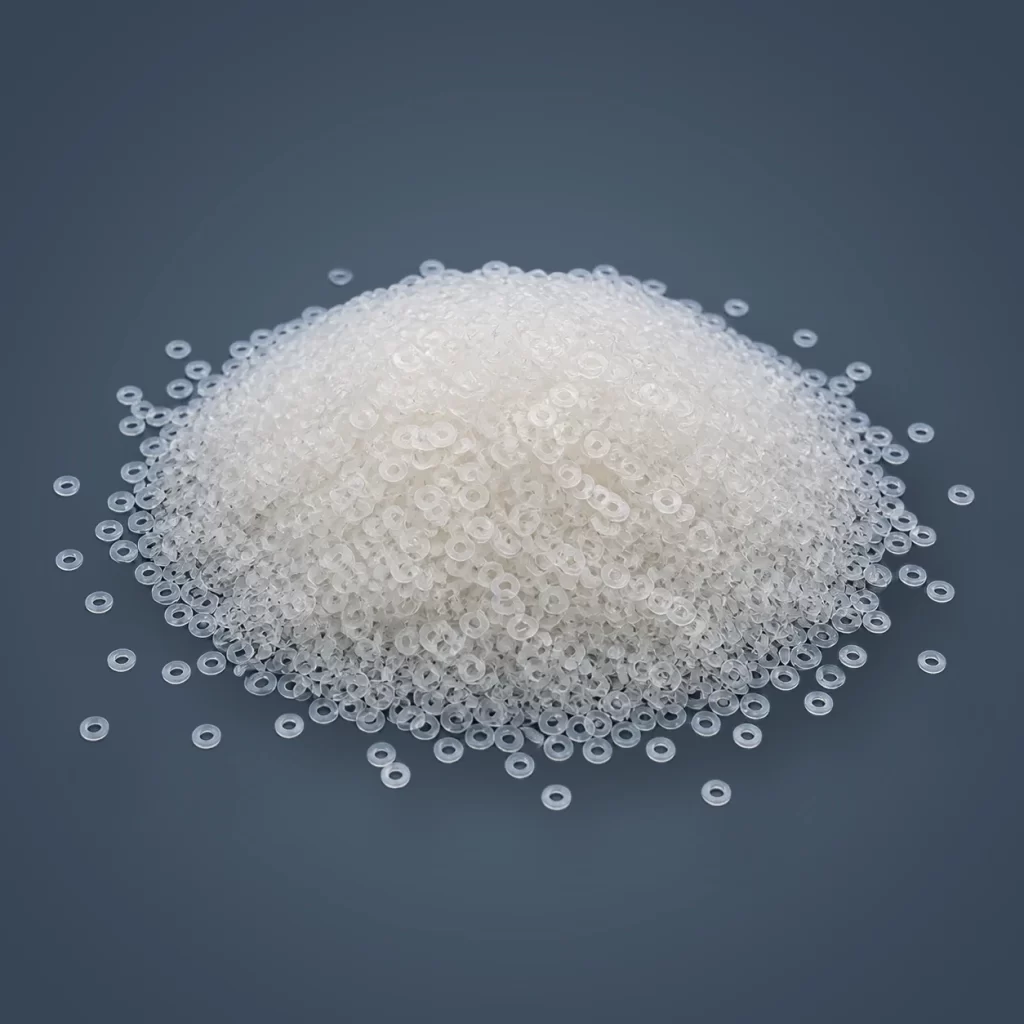
A small PTFE washer is a thin, precision-cut ring—typically from 2 mm to 20 mm in inner diameter—used as a spacer, a seal face, an electrical insulator or a bearing-face thrust washer. Because PTFE is chemically inert, self-lubricating and stable across a huge temperature window, these tiny parts are the unsung heroes of electronics, medical devices, food-processing pumps and laboratory hardware. Unlike bulk gaskets, small washers live inside tight assemblies where a few microns of stack-up error can jam a mechanism, which is why precision, not price, should drive the spec.
Precision Tolerances: Why Small PTFE Parts Are Different
PTFE is soft, springs back and creeps under load, so it cannot be machined to metal-grade tolerances on every run. Realistic linear tolerances on machined PTFE are commonly +/-0.05 to +/-0.10 mm, with hole diameters around +/-0.05 mm and flatness of 0.05–0.15 mm per 100 mm, as detailed in Felis’s guide to PTFE tolerance limitations. Industry standards frame the expectation: the German pro-K association’s technical sheet on tolerances for machined PTFE parts cites EN ISO 286-1 IT-grade bands for blanked parts up to 3 mm thick, while Valqua’s notes on JIS K 6884 general tolerances set the Japanese baseline for compression-machined PTFE. Even a specialist like Goodfellow lists a generous +/-0.5 mm diameter on off-the-shelf PTFE discs—proof that unless you order a held tolerance, you will not get one (see the Goodfellow PTFE disc tolerance table). Always anneal before final machining: it stabilizes dimensions and kills the post-autoclave swelling that sank that injector line.
Standard Sizes vs. Fully Custom Small PTFE Washers
For generic fastener isolation, stock flat washers to DIN 125 A / ISO 7089 dimensions (M4, M5, M6, etc.) are cheap and instant. But once your ID, OD or thickness falls outside a standard fastener size, you move to custom die-cut or CNC-machined parts—which is where most medical, electronics and fluid-handling buyers land. If your design needs an even thinner profile, compare our thin PTFE washers, or step up to a solid PTFE gasket for heavier flange-duty equivalents of the same sealing logic.
Material Properties: Chemistry and Temperature
Virgin PTFE resists virtually all chemicals across pH 0–14 and runs from roughly -268 °C to +260 °C continuously (short bursts to 315 °C), and is physiologically harmless and FDA-compliant—see the TEADIT PTFE properties brochure. For wear-critical interfaces, PTFE washers rarely act alone: they pair with PTFE wiper seals on reciprocating rods and PTFE wear rings on rotating shafts, where the low-friction, non-galling surface prevents metal-on-metal scoring.
Design Tips That Prevent a Second Sample Round
Three small drawing choices save weeks. First, specify the controlled dimension explicitly—usually the bore that mates to your shaft—rather than asking for “tight tolerance everywhere,” which drives up cost. Second, call out the filler only where you need it: virgin PTFE is the right default for chemical and food contact, while glass- or carbon-filled PTFE buys better wear and lower creep for dynamic washers. Third, allow a small lead-in chamfer and specify batch annealing in the note, so the washer survives repeated sterilization without drifting. Supplying a 2D drawing with a dimension table removes the guesswork that causes first-article rejections.
MOQ, Lead Time and Certification
A professional OEM should accept trial orders of 100–500 custom small PTFE washers, quote 5–10 days for die-cut runs and 10–20 days for CNC-prototyped precision parts, and ship first-article samples with a dimension report before mass production. Ask for FDA 21 CFR 177.1550, RoHS and REACH declarations for food, medical and electronic contact, and a dimensional inspection certificate on ID, OD and thickness. Brands A, B and C all promise tolerances in their catalogs; the supplier that puts a micrometer reading in writing is the one worth scaling with.
Frequently Asked Questions
What tolerance can you hold on custom small PTFE washers?
Machined small PTFE washers are typically held to +/-0.05 mm on diameters and +/-0.05 to +/-0.10 mm on thickness, with annealing before final machining to stabilize dimensions against thermal cycling and autoclaving.
What is the minimum order quantity (MOQ) for small PTFE washer wholesale?
Trial custom orders usually start at 100–500 pieces; stock standard flat washers can be supplied with little or no MOQ. Unit cost drops sharply at 5,000+ pieces.
Can you produce non-standard inner diameter, outer diameter and thickness?
Yes. We machine to your drawing across IDs from about 2 mm upward, with custom OD and thickness from 0.25 mm, including non-round slots, chamfers and marked parts.
Are small PTFE washers suitable for medical and food contact?
Virgin PTFE grades can be supplied with FDA 21 CFR 177.1550 and USP-class-compatible documentation; they are physiologically harmless, non-contaminating and autoclavable.
What temperature range do PTFE washers withstand?
PTFE washers perform from about -268 °C up to +260 °C continuous service, with short-term resistance near 315 °C, and remain chemically inert across pH 0–14.
Which industries use small PTFE washers most?
Medical devices, analytical and laboratory instruments, electronics and connectors, food and beverage pumps, semiconductor handling and precision pneumatic systems are the heaviest users.
Disclaimer
This article is provided for general informational purposes only and reflects typical industry ranges as of the publication date. It is not engineering, legal or procurement advice. Actual performance depends on mating hardware, media, temperature, assembly load and sterilization regime; always validate parts with qualified engineers and your supplier. Competitor references (brands A, B and C) are anonymized for comparison. Consult the cited manufacturer and standards documents for authoritative tolerances and material data.