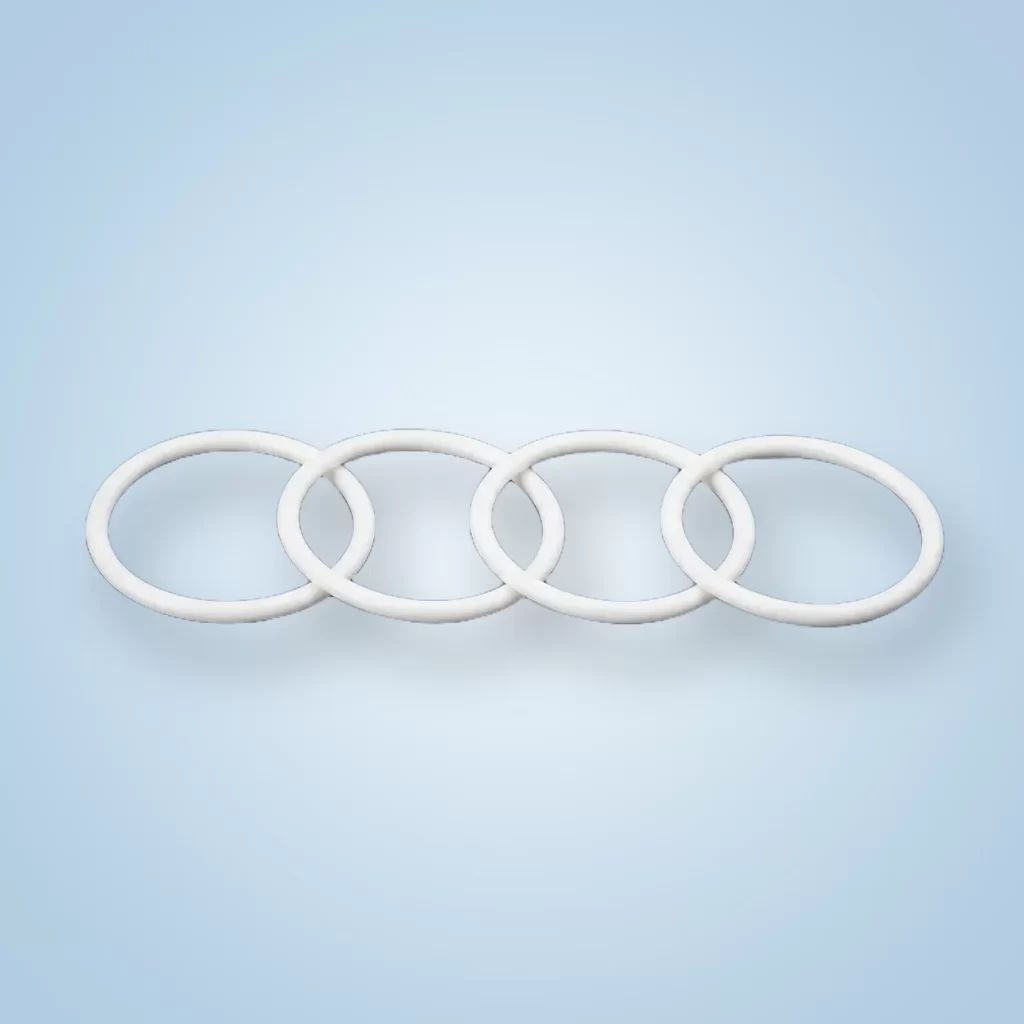
Meta Title (58 chars): Guarnizioni in PTFE massiccio su misura | Fornitore all’ingrosso di guarnizioni in PTFE
Meta Description (152 chars): Source custom Solid PTFE gaskets from an ISO 9001 PTFE gasket manufacturer. Virgin, filled & ePTFE grades, ASME B16.21, FDA-compliant, low MOQ.
URL Slug: custom-solid-ptfe-gaskets-wholesale
Imagine your plant loses eight production hours on a Monday morning. A 4-inch raised-face flange joint on a hydrochloric-acid line weeped after the second heat-up cycle. You swapped in another “identical spec” virgin PTFE ring, and three shifts later the joint leaked again — the PTFE had crept under bolt load until the contact stress collapsed. For engineers and procurement teams sourcing Solid PTFE Gaskets, that gap between a $2 part and a $50,000 unplanned shutdown is exactly why wholesale and custom PTFE gaskets demand a sharper sourcing process than most buyers give them.
What Are Solid PTFE Gaskets, and Why Do Engineers Keep Specifying Them?
Solid PTFE gaskets are flat, machined or skived rings cut from compression-molded PTFE (polytetrafluoroethylene) billets or skived virgin PTFE gasket sheets. Unlike elastomer O-rings or spiral-wound metallic gaskets, a solid PTFE gasket is 100% fluoropolymer: it offers near-universal chemical resistance (pH 0–14, except molten alkali metals and elemental fluorine), a service window from roughly −200 °C to +260 °C (−328 °F to +500 °F), and a dielectric strength that makes it the default seal for corrosive, cryogenic, or high-purity piping.
The trade-off every engineer must know is PTFE’s tendency to cold-flow. As Garlock’s sealing-engineering reference notes, unfilled PTFE “flows (creeps) under relatively low loads, even at room temperature” — a property that, more than chemical attack, drives most field failures.
Virgin, filled, and expanded PTFE: pick the grade before you quote
- Virgin PTFE is 100% unfilled resin. Highest purity and chemical resistance, but lowest creep resistance. Best for food, pharma, semiconductor, and aggressive acid service.
- Filled PTFE blends glass, carbon, graphite, or bronze into the resin to cut cold flow and raise compressive strength. Our glass-filled PTFE gaskets are the common choice for higher-pressure flanges and pump casings.
- Expanded PTFE (ePTFE) is a fibrillated, porous sheet engineered to conform to rough or uneven flanges at low bolt load. References such as GORE GR Sheet Gasketing describe ePTFE as eliminating the creep and cold flow conventional PTFE is known for — at a premium price.
Wholesale vs. Custom: How a Real PTFE Gasket Manufacturer Should Quote Your Job
Buyers typically fall into two camps. Wholesale PTFE gaskets mean repeatable catalog sizes (ASME B16.5 Class 150/300 rings in ½″–24″) at landed cost with predictable lead times. Custom Solid PTFE gaskets mean non-standard OD/ID/thickness, special fillers, encapsulated edges, or printed identification to a drawing.
A competent PTFE gasket manufacturer should handle both from the same ISO 9001 shop: skive from virgin sheet, CNC-turn rings, or die-cut to a print, and supply a material test report with every batch. If your supplier only stocks one white ring and cannot name the resin grade, filler loading, or compression-set test method, you are buying a commodity, not a seal. For a deeper walkthrough of drawing-based production, see our companion Solid PTFE gasket sourcing guide.
The Six Questions Every Buyer Should Ask Before Placing an Order
After 15+ years quoting across chemical, food, semiconductor, and OEM accounts, we see the same mistakes recur. Ask these six up front.
1. What temperature and pressure will the joint actually see?
Solid virgin PTFE tops out around 260 °C continuously; above that, or under flange pressures above roughly 20 bar, creep becomes a design problem. Always derate for cyclic service and confirm whether the flange is raised-face or flat-face.
2. Should I order to ASME B16.21 dimensions?
ASME B16.21 defines types, sizes, materials, tolerances, and marking for nonmetallic flat gaskets used with B16.5 and B16.47 flanges. If your job goes onto ASME flanges, specifying B16.21 by size and class removes 90% of fit-up arguments.
3. Do you need FDA / food-contact compliance?
For food, pharma, or cosmetic contact, the relevant U.S. benchmark is FDA 21 CFR 177.1550, which covers perfluorocarbon resins used in repeated food contact. Ask the supplier for a current letter of compliance and resin lot traceability — not just “food-grade white.”
4. What is the practical MOQ and lead time?
Solid gaskets are made-to-order: samples typically ship in 3–5 days, production in 7–15 days depending on size and filler. Low-MOQ programs let small OEMs prototype without committing to thousands of rings — something Brand A and Brand C catalog houses rarely support without a setup fee.
5. Virgin, filled, or ePTFE for this flange?
If the flange is old, pitted, or non-standard, expanded PTFE gaskets conform far better than skived solid sheet. If pressure and temperature are high, choose filled. If purity is non-negotiable, stay virgin. There is no single “best” grade.
6. How thick should the gasket be?
Thicker gaskets conform better but relax faster. Most raised-face flange joints use 1/16″ (1.5 mm) or 1/8″ (3 mm) solid PTFE; large, uneven, or glass-lined flanges often use 1/8″ or ePTFE tape. Follow the flange standard and the equipment vendor’s torque sheet.
How Do Brand A, Brand B, and Brand C Compare in Practice?
We won’t name names, but after benchmarking against three import catalog brands, the pattern is consistent. Brand A ships cheap virgin rings with inconsistent sheet thickness — fine for low-pressure water, risky for acid service. Brand B markets heavily on “ePTFE” but the material is really calendared expanded tape sold at premium pricing, with creep-relaxation behavior that does not match true oriented ePTFE. Brand C lists wide catalog ranges but cannot handle drawings outside standard sizes.
The lesson is that price per ring is a poor metric. A gasket that lasts 12 months vs. six months is a 200% difference in total cost, even if the up-front price differs by only 15%. One DuPont case study illustrates the cost of getting this wrong: PTFE instrument gaskets had to be replaced every 6–12 months on a process sensor because the material’s inelasticity could not absorb thermal cycling.
Frequently Asked Questions
Q1. What is the temperature and pressure range of solid PTFE gaskets?
Virgin solid PTFE is generally rated −200 °C to +260 °C (−328 °F to +500 °F). Pressure capability depends on filler, thickness, flange condition, and bolt loading; conservative guidance for unfilled sheet is under ~20 bar at room temperature, with derating at elevated temperature.
Q2. What is the difference between virgin, filled, and expanded PTFE gaskets?
Virgin is pure resin — highest purity, highest chemical resistance, most creep. Filled grades blend glass/carbon/graphite/bronze for better creep and compressive strength. Expanded PTFE (ePTFE) is fibrillated porous sheet that conforms to uneven flanges at low bolt load.
Q3. Can you manufacture custom Solid PTFE gaskets to my drawing, and do you follow ASME B16.21?
Yes. We CNC-machine and skive rings to your OD, ID, and thickness, with filler and color options. Standard ASME B16.21 sizes are held in-house; custom drawings are quoted with tolerance and material grade.
Q4. What is the MOQ and typical lead time?
Samples ship in 3–5 days; production runs 7–15 days after drawing approval. Low MOQ is available for custom projects; standard catalog sizes are quoted per volume.
Q5. Are your PTFE gaskets FDA-compliant for food and pharmaceutical use?
Virgin PTFE can be supplied to meet FDA 21 CFR 177.1550 food-contact requirements, with lot traceability and a material test report. Filled grades should be confirmed case-by-case, since fillers may not carry food-contact approval.
Q6. How do I choose gasket thickness for my flange?
For standard raised-face ASME flanges, 1/16″–1/8″ solid PTFE is typical. Thicker (1/8″, 3 mm) or ePTFE is preferred for rough, pitted, or non-standard flanges. Always follow the flange standard and the equipment vendor’s bolt-torque specification.
Disclaimer
The content in this article is provided for general informational purposes only and does not constitute engineering, design, or procurement advice. Actual gasket selection must be validated against specific media, pressure, temperature, flange geometry, and applicable codes by a qualified mechanical or process engineer. Always reference current ASME, ASTM, FDA, and industry standards and consult your PTFE gasket manufacturer for application-specific recommendations.